Wednesday

Roman Roads

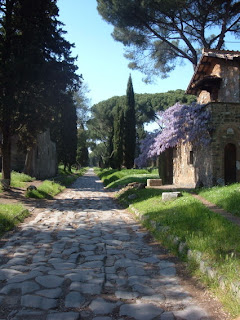
Roads were very important to Rome. They were so important because in an enormous empire,such as Rome, they needed a way to get from place to place in a timely manner.The roads provided fast and easy access to many miles of territory. All the labor done on the roads was done by the Roman soldiers.

There were many steps required in the building of the Roman roads. It was a long process, but it still benefits us today. Here is a list of what was required of the roads of Rome...
"*Roman roads were generally laid out in a straight line ( although they sometimes followed natural curves )
*Ancient surveying techniques using 'Sighting Marks' were used

*The ground was cleared of any trees

*A trench where the road was to go was dug and then filled with big stones creating an embankment

*Roads were generally built on top of an embankment ( called an Agger ). Romans were the first to build roads on this foundation basis

*The foundation, or Agger, contained a layer of rubble with stones which were laid in such a way as to provide drainage

*A middle section consisting of a layer sand or gravel and sand was laid on the foundation

*The top surface of the roads were paved roads with gravel or flint and small broken stones

*There were ditches on either side so water could drain away

*Road widths measured between 8 and 40 feet - wide enough to take a Roman chariot with two horses

*There were even lay-bys allowing other chariots past!"(source)

The roads consisted of three layers. There was the foundation, which was usually made of stone. There was a middle layer, which was made of sand or gravel. And the surface was made of gravel or paving stones. The most top layers of the roads were laid more carefully and were made with finer materials.

The most important thing about the foundation of the Roman roads is its ability for drainage. If the foundation was not able to drain, the road would eventually become uneven. To encourage runoff, the roads were peaked in the center with sloping sides. The roads were also built in very straight paths. For example, if there was a swamp or mountain, rather than going around it, the Romans would build right through them.

The Via Appia (Appian Way) is known to be the most important road in Rome. It is also known as The Queen of Roads. It connected Rome with Brindisi and Apulia(which are located in Southwestern Italy).

"The Roman army, for its success, depended on the use of highways to prepare for battle and to afterward refresh and re-equip. The specific Via Appia was used as a main route for military supplies for many years from the middle of the 4th century BC. Bases allowed the Romans to keep large numbers in the field waiting for the opportunity to strike. In the late Republic the Romans were masters of road construction, but this art was not yet in their repertory until their territory expanded. The few roads outside the early city were Etruscan and they were not used to connect bases or supply troops."(source)
Barnett, Mary. Gods and Myths of the Romans: the Archaeology and Mythology of Ancient Peoples. Smithmark Publishers. New York. 1996
Hadas, Moses. Imperial Rome. Time Inc Publishers. Canada 1965


Daily Life in Ancient Rome

Anybody could apply to be a Roman citizen, but not everybody who applied was fortunate enough to become a citizen. Unlike the Greeks, the Romans were down-to-earth. Also unlike the Greeks, the Romans were realists This can be seen in Roman statues/art. Romans would show things the way they really were, not the way they were "supposed to be".

The Romans were great builders. There were many roads built all over the empire Rome. Every single one of the roads led to Rome. The Greeks had roads as well, but they weren't as high of quality as those of Rome. They also didn't connect in any particular order, since they had nothing to connect to. They didn't have anything to connect to because Greece was divided into city-states. Whereas Rome was the center of the empire.

"For the majority of persons dining in Ancient Rome, meals were centered around corn (grain), oil and wine, and, for the wealthy, different types of exotic foods. Cereals were the staple food, originally in the form of husked wheat (far) being made into porridge (puls), but later naked wheat (frumentum) was made into bread. Bread was the single most often eaten food in Ancient Rome, and was sometimes sweetened with honey or cheese and eaten along with sausage, domestic fowl, game, eggs, cheese, fish, or shellfish."(source)

Roman men wore togas over a tunic. Togas were expensive and made of heavy white wool. They were expensive because they were made well. It required to be cleaned very often. There were many different types of togas...

"*Toga Praetexta: Characterized by a purple stripe, worn by curule magistrates as well as boys until the age of 15 or 16.

*Toga Virilis: The plain toga of a typical citizen. Worn by boys after age 15 or 16

*Toga Picta: A crimson toga embroidered with gold, donned by victorious generals in triumphal processions and the emperors.

*Toga Candida: A toga given a shiny, glossy look by rubbing it with chalk, worn by people running for public office.

*Toga Pulla: Made of natural black wool and worn in funerals." (source)

Roman women wore tunics. And married women wore a stola over the tunic. Most Roman women wore their tunics gathered at the side with a brooch. This was the most common way Roman women dreesed.

"In terms of makeup, a woman's face powder was a mixture of powdered chalk and white lead. Rouge for cheeks and lips was acher or the lees of wine. Eyebrows and eyelashes were blackened with ashes or powdered antimony, and teeth glistened with enamel. A lady chose her jewels, a diadem of precious stones for the hair, earrings, at least one necklace, rings for her fingers, bracelets for her wrists, and circlets for her ankles. "(source)

Barnett, Mary. Gods and Myths of the Romans: the Archaeology and Mythology of Ancient Peoples. Smithmark Publishers. New York. 1996

Hadas, Moses. Imperial Rome. Time Inc Publishers. Canada 1965

Saturday

Roman Architecture and Art

Roman art and architecture had a huge impact on the art and architecture of today. One of the ways Roman architecture is similar to today's architecture can be seen in the structure of cities. When Roman architecture began it was merely copies of Greek architecture. Romans eventually created their own form of architecture by developing new building materials and creating unique shapes and forms.

"The typical Roman city of the later Republic and empire had a rectangular plan and resembled a Roman military camp with two main streets—the cardo (north-south) and the decumanus (east-west)—a grid of smaller streets dividing the town into blocks, and a wall circuit with gates. Older cities, such as Rome itself, founded before the adoption of regularized city planning, could, however, consist of a maze of crooked streets. The focal point of the city was its forum, usually situated at the center of the city at the intersection of the cardo and the decumanus. The forum, an open area bordered by colonnades with shops, functioned as the chief meeting place of the town. It was also the site of the city's primary religious and civic buildings, among them the Senate house, records office, and BASILICA, (q.v.). The basilica was a roofed hall with a wide central area—the nave—flanked by side aisles, and it often had two or more stories. In Roman times basilicas were the site of business transactions and legal proceedings, but the building type was adapted in Christian times as the standard form of Western church with an apse and altar at the end of the long nave. The first basilicas were put up in the early 2d century bc in Rome's own Forum, but the earliest well-preserved example of the basilicas (c. 120 bc) is found at Pompeii."(source)

Some of the most famous and beautiful peices of Roman art were statues. Roman statues were usually made of marble or clay, and sometimes some metal would be added. The statues were made of gods or important leadrers. The people/gods that the statues were made of were usually nude. Since the statues were made in honor of the gods/leaders, the Romans belived that they should be made of the best quality materials.

Statues were very common in Rome. Romans liked statues because they depicted the god/leader in a very realistics manner. They reinforced Roman artistic convention. They also popularized Roamn artistic convention.

Thew Roman Colosseum is one of the most famous buildings in Rome. The Colosseum was built in 80 A.D. near Nero's "Golden House". It was called the Colosseum because of Nero's Colossus that was near by. The Colosseum consists of four floors.

"The huge theater was originally built encompassing four floors. The first three had arched entrances, while the fourth floor utilized rectangular doorways. The floors each measured between 10,5-13,9 meters (32-42 feet) in height. The total height of the construction was approximately 48 meters (144 feet). The arena measured 79 x 45 meters (237-135 feet), and consisted of wood and sand. (The word "arena" is derived from the Latin arena, which means "sand.") Nets along the sides protected the audience."(source)

Barnett, Mary. Gods and Myths of the Romans: the Archaeology and Mythology of Ancient Peoples. Smithmark Publishers. New York. 1996

Hadas, Moses. Imperial Rome. Time Inc Publishers. Canada 1965

The Importance of Caesar Augustus


Caesar Augustus (which means the exalted one)was born on September 23, 63 B.C. in Rome, Italy. He was the first Roman emperor. He ruled from 23 B.C.-14 A.D. He was the son of Gaius Octavias and Atia. He was later adopted by his uncle, Julius Caesar. He had two wives (Livia Drusilla and Scribonia), one daughter (Julia), and three sons (Tiberius, Gaius, and Lucius), all of which were adopted.

The first triumvirate came to an end when Crassus and Pompey died and Julius Caesar was assassinated. Caesar Augustus was chosen by his uncle/adopted father, to be the heir to his throne. Caesar Augustus was part of the second triumvirate, along with Marc Antony and Lepidus.

"Second Triumvirate: After Caesar had been killed, Marc Antony controlled the republic, but he had to do business with with the assassins, Brutus and Cassius. He made them governors of provinces in the east. However, Caesar's adopted son Octavian thought this was too kind, and exploiting the anger of Caesar's veterans, he launched a war against Antony, who was defeated at Modena in northern Italy. After his victory, Octavian returned to Rome, demanded the consulship, and surprised the world with the creation of an alliance with... Marc Antony. This remarkable volte-face had been designed by Marcus Aemilius Lepidus, like Antony a former general in Caesar's army. He became the third member of the Second Triumvirate, which was recognized in November 43 by the People's Assembly." (source)

After the death of Lepidus and Marc Antony, Caesar Augustus became the sole ruler of Rome. While he was the sole ruler of Rome he brought all civil wars to an end. He also built roads, public baths, bridges, and government buildings. He brought Rome a period of peace, prosperity, and imperial greatness, which is known as the Pax Romana.

Caesar Augustus was a big part of Roman history. He was the cause for many great things in Rome. He brought peace to Rome, not only during his rule, but for 100 years. This shows his love and devotion from his followers.

Thursday

The Government of Ancient Rome

From the time Rome was founded, to the time it fell, it was an odd combination of a republic and a democracy. Many of the ideas of Roman government came from the Greek govermnet. just as the Romans took ideas of thr Greek government, we took the Roman idea of the three branch system of government.

For 2,000 years Rome had, essentially, the same government system. This prevailing government system was the Roman Rebublic. The Roman Rebuplic began in 500 B.C. and lasted until 1500 A.D. There were two consuls in charge of the Roman Republic. Theseconsuls were in charge of the army/war.

Under the consuls, there were many other rulers. There were pretors, who were in charge of the courts. They were the chief law officers. There were also aedlles who were in charge of markets and construction. There were also censors. The censors were in charge of filling any vacancies in the Senate.

In Rome there began what is known as the first triumvarate. it consisted of three men, Pompey, Cassus, and Julius Caesar. Though each of the men in the triumvarate Caesar was overwhelmimgly popular among the citizens of Rome. Caesar then ends up havung an affair with Cleopatra VII. His affair eventually causes his death.

Then the second triumvirate was formed. It consisted of Octavian, Marc Antony, and Lepidus. It was created in 43 B.C.in many ways our government is like that of Ancient Rome. Although in some aspects our government is completly differnet.

Barnett, Mary. Gods and Myths of the Romans: the Archaeology and Mythology of Ancient Peoples. Smithmark Publishers. New York. 1996

Hadas, Moses. Imperial Rome. Time Inc Publishers. Canada 1965

Saturday

The Aeneid and The Odyssey

Vergil, a Roman poet, was the author of The Aeneid. His real name was Publius Vergilius Maro. He was born on October 15th in 70 B.C. Although he was a Roman poet, he was originally from Ireland. Virgil studied science, astronomy, and philosophy under the Epicureans.

Homer was a Greek poet who attributed many great epics, one of them being The Odyssey. Homer was born in a Greek colony on the coast of Asia Minor around 1200 B.C. There have been arguments for a long period of time regarding weather or not Homer’s works were really written by him. Nothing about Homer can be known as completely factual.

“The Aeneid follows prince Aeneas and fellow Trojans as they sail to Italy after the fall of Troy. Aeneas suffers many hardships and sacrifices as the warrior prepares for his destiny: personifying the virtues that would bring a rebirth and golden age to Rome. Considered a fictional narrative, Virgil's myth-history brims with immortals, gods and goddesses, and glorification of Rome under its first emperor, Augustus, to whom Virgil dedicated his epic work.” (source)

The Odyssey is a Homeric poem about a man named Odysseus. The Odyssey tells the of the 10 year struggle of Odysseus while he’s trying to get back home after the Trojan War. Odysseus battles divine creatures and faces the rage of the gods. “His wife Penelope and his son Telemachus stave off a gaggle of suitors vying for Penelope's hand and the throne of Ithaca long enough for Odysseus to return. The Odyssey ends as Odysseus wins a contest to prove his identity, slaughters the suitors, and retakes the throne of Ithaca.” (source)

These two books and authors are very different, but they are similar as well. The Aeneid was non-oral and was developed with the aid of writing. However, in The Odyssey there were forms of improvised techniques that were utilized. Vergil imitates Homeric language in his plays. Vergil imitates the Homeric simile. He also uses some of Homer's poems as a basis for his story patterns.

Barnett, Mary. Gods and Myths of the Romans: the Archaeology and Mythology of Ancient Peoples. Smithmark Publishers. New York. 1996

Hadas, Moses. Imperial Rome. Time Inc Publishers. Canada 1965

Wednesday

Foundation Myths of Ancient Rome


Nobody is really sure who founded Rome. Some believe that Aeneas was responsible for it. Others believe that Romulus, and his twin brother, Remus founded Rome. Both assumptions are based on legend. The story of Romulus and Remus is a little far-fetched compared to the story of Aeneas.

The story of Romulus and Remus goes something like this: Romulus and Remus were the sons of Vestal Virgin and Rhea Silvia. When the twins were born, Numitor (their grandfather) wished to have them put to death. The boys were then left on a river bank. Left for dead, the boys were found by a she-wolf. The she-wolf nursed the boys and a woodpecker fed and guarded them.

Faustulus, a swineherd, took them into his care. He gave them a fine education. The boys grew up to have incredible strength and looks. Romulus, the name that inspired Rome, killed his brother Remus in a fight over which one of them would rule over Rome. It is recorded that Romulus served as the first king of Rome.

The story of Aeneas, also based on myth, is more believable and real: Aeneas is known to some as the father of Rome. Aeneas is a heroic character in the Iliad.
it is prophesied that the descendants of Aeneas would be kings . It is recorded by historians that Aeneas founded Rome and named it "Rhome", meaning strength.

These two ideas of the founding of Rome are very different. Though they are similar in the fact that they are both based on myth. One of these myths is more believable than the other, but they are both ,still, very trusted in. I guess we will never know how Rome was really founded and who founded it.


Barnett, Mary. Gods and Myths of the Romans: the Archaeology and Mythology of Ancient Peoples. Smithmark Publishers. New York. 1996


Marks, Anthony, and Graham Tingay. The Romans. Usborne. London. 1990.